
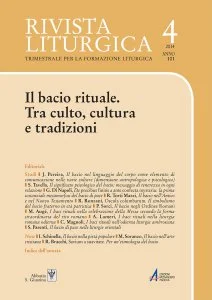
Description
S. Parenti pp. 775-788
Il bacio di pace nelle liturgie orientali
Il bacio è ancora oggi una delle espressioni più tipiche delle culture orientali cristiane. Insieme all’abbraccio che lo accompagna resta nelle relazioni sociali, a tutti i livelli, un gesto spontaneo e non stilizzato. Per questo motivo si resta perplessi quando si prende atto che in molte tradizioni liturgiche dell’Oriente cristiano il bacio di pace della sinassi eucaristica è scomparso quasi del tutto e continua a essere scambiato soltanto dai ministri ordinati. In Oriente il bacio è presente, secondo le varie tradizioni, in diversi momenti dell’anno liturgico. A livello verbale e gestuale il modello di riferimento è l’attuale rito romano o, piuttosto, la sua versione europea, la più accessibile e mediaticamente più presente. Da un punto di vista liturgico e culturale rappresenta però un fallimento del quale, certamente, il rito romano non ha nessuna colpa. Nei fatti viene formalizzato un doppio «segno di pace», uno per il presbiterio con il bacio e l’abbraccio, l’altro per la navata con la stretta di mano e per di più introdotto da due distinte monizioni. Se all’inizio della Quaresima e a Pasqua tutti si baciano e si abbracciano, non si capisce perché in una liturgia domenicale le stesse persone si debbano dare una stretta di mano, un segno del tutto estraneo alla cultura liturgica dell’Oriente cristiano.
The kiss of peace in the Eastern liturgies
The Kiss is still now one of the most typical expressions of the Eastern Christian cultures. Together with the embrace that is joined, it remains within social relationships, at all levels, a spontaneous, not stylized gesture. For this reason, we are perplexed when we realize that in many liturgical traditions of the Christian Eastern the kiss of peace in the Eucharistic synaxis has almost completely disappeared and continues to be exchanged only by the ordained ministers. In the Eastern liturgy the kiss is present, according to the various traditions, in different moments of the liturgical year. At a verbal and gestural level, the reference model is the Roman rite of today, or rather its European version, the most reachable and the most present in the mass media. But from a liturgical and cultural point of view, all this means a failure, of which the Roman rite is surely not guilty in any way. Actually it is formalized a double «sign of peace»: one for the presbytery, with kiss and embrace, the other for the nave with an handshake, and moreover this sign is introduced by two different monitions. If at the beginning of Lent and at Easter all kiss and embrace one another, one cannot understand why in a Sunday liturgy the same people shall give themselves an handshake, a sign completely foreign to the liturgical culture of the Christian Eastern.


Reviews
There are no reviews yet.