
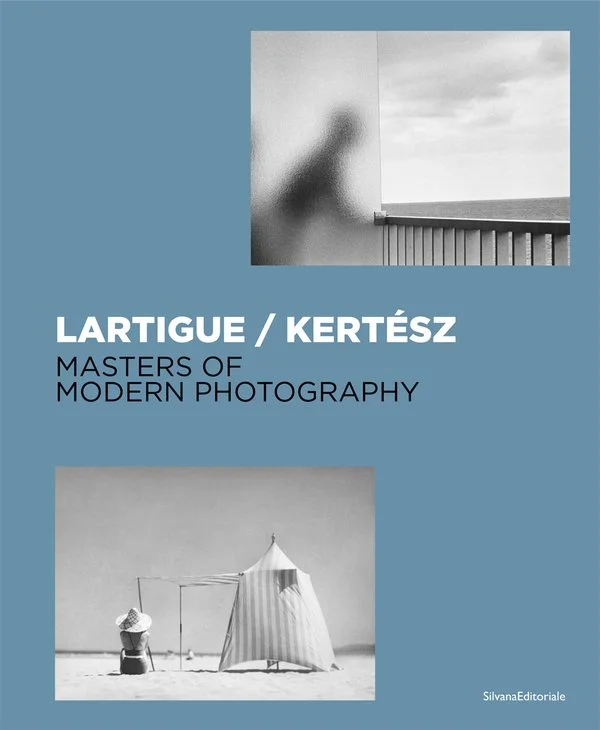
Description
Jacques Henri Lartigue (1894–1986) and André Kertész were born in the same year. Their lives spanned most of the 20th century and their paths could have crossed in Paris between the two world wars, but the two did not meet until 1973 in New York. Neither Lartigue nor Kertész followed the most direct route to recognition. Their respective exhibitions at the Museum of Modern Art in New York in 1963 and 1964 proved to be a watershed moment, signalling for Lartigue the beginning of international and institutional recognition and for Kertész the rediscovery of his work after two decades of relative obscurity.
These two events also anchored the practice of both photographers in the first half of the 20th century, identifying them as the precursors of visual modernity, with Lartigue being described as a “primitive amateur” and Kertész as the “inventor of photojournalism”.
Lartigue was considered a master of the snapshot and Kertész of reflective photography. They developed their body of work in complete freedom, independently of major artistic movements, and from the 1970s these two independent personalities were viewed as role models in their own right.
The parallel display of their photographs shows not only how their lives and points of view converged and diverged, but also their being complementary figures in the history of photography.
Reviews
There are no reviews yet.